
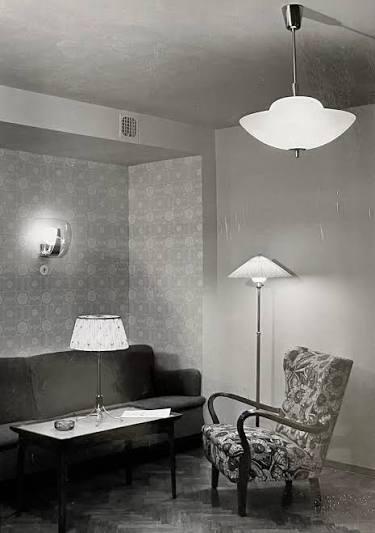
Swedish Grace: The Elegant Swedish Style of the 1920s, 1930s and Early 1940s
Swedish Grace is one of the most elegant and distinctive periods in Swedish design history. Emerging particularly during the 1920s, the style continued to influence Swedish furniture, interiors and decorative arts through the 1930s and, in some forms, into the early 1940s.
Often described as the Swedish interpretation of Art Deco, Swedish Grace developed alongside the international Art Deco movement while retaining its own distinctive character. Swedish designers combined classical inspiration, geometric forms, refined ornament and exceptional craftsmanship with a distinctly Swedish approach to interiors.
Swedish Grace was not simply a brief period between older classical design and modernism. It was part of a gradual evolution in Swedish design, with Swedish Grace, Art Deco and Functionalism overlapping for many years.
From furniture and lighting to glass, textiles and architecture, Swedish Grace created an aesthetic that remains remarkably relevant today.
What Is Swedish Grace?
Swedish Grace is the name commonly used for the Swedish design style that flourished particularly during the 1920s. The term was coined later, in the 1930s, by the English journalist and writer Philip Morton Shand, who used it to describe the elegance he encountered in Swedish decorative arts.
The period is closely associated with Swedish classicism and the sophisticated interiors of the 1920s.
The Stockholm Exhibition of 1930 marked an important turning point in Swedish design. Functionalist and modernist ideas were presented to a much wider Swedish audience, helping to accelerate the movement toward modern Scandinavian design.
However, 1930 did not mark the sudden end of Swedish Grace.
Classical furniture, decorative arts and interiors continued to be produced throughout the 1930s, and elements of Swedish Grace remained visible into the early 1940s. The transition from Swedish Grace to Functionalism was gradual, with different approaches existing alongside one another.
The Origins of Swedish Grace
Swedish Grace developed from several overlapping influences.
One was Swedish classicism. Designers looked to ancient Greece and Rome, as well as Swedish Gustavian traditions, for proportions, symmetry and decorative motifs.
At the same time, international Art Deco was influencing European and American design. Geometric forms, stylised ornament and luxurious materials became increasingly fashionable during the 1920s.
Swedish designers absorbed these international influences while maintaining a strong connection to Nordic craftsmanship and Swedish architectural traditions.
The result was a distinctive style characterised by balanced proportions, geometric forms, classical references and refined decorative details.
Swedish Grace was therefore contemporary with Art Deco rather than simply following it.
The Characteristics of Swedish Grace
Swedish Grace can be recognised by a combination of classical proportions, geometric forms, stylised ornament and carefully chosen materials.
Typical characteristics include:
- Symmetrical and balanced forms
- Geometric decoration
- Classical architectural details
- Stylised floral and natural motifs
- Refined and often muted colour palettes
- Fine woodwork
- Brass and other refined metals
- Marble and stone
- High-quality textiles
- Elegant, sculptural lighting
- Decorative inlays and carved details
- Strong emphasis on proportion and craftsmanship
Swedish Grace was not an undecorated style.
Ornament remained an important part of the design language. Decoration could appear as carved details, geometric patterns, stylised natural motifs, marquetry, inlays, painted surfaces and decorative metalwork.
The defining quality was not the absence of decoration but the way decoration was integrated with proportion, materials and craftsmanship.
Swedish Grace Furniture
Swedish Grace furniture is particularly admired for its elegant proportions and exceptional craftsmanship.
Furniture from the period often combines traditional cabinetmaking with more simplified geometric forms. Chairs, tables, cabinets, desks and seating may feature classical details, tapered legs, rounded corners, decorative inlays or carefully executed carving.
Light-coloured woods were important, although darker woods were also used. Marble, brass and textiles could be incorporated to create a sense of luxury.
Furniture from the later 1930s can be particularly interesting because it demonstrates the transition toward modernism. Classical references could remain while silhouettes became simpler and more functional.
This makes Swedish Grace an important bridge between earlier Swedish classicism and the Scandinavian Modern furniture that followed.
Swedish Grace Lighting
Lighting is an especially interesting part of Swedish Grace interiors.
Pendant lights, chandeliers, wall lights and table lamps were often treated almost as architectural elements. Brass, glass and painted metal were used to create fixtures that were both functional and decorative.
Geometric shapes and classical references frequently appear in Swedish Grace lighting. Opaline and frosted glass could be combined with brass or other metals to create a soft and elegant light.
The decorative character of the period is particularly visible in chandeliers and ceiling fixtures, where symmetry, repeated geometric forms and sculptural details could create a strong focal point.
During the 1930s and early 1940s, lighting increasingly reflected functionalist ideas, but classical and decorative forms continued to coexist with the new modernist aesthetic.
Swedish Grace Glass
Glass played an important role in Swedish decorative arts during the period.
Swedish glassmakers and artists developed highly sophisticated forms, combining elegant silhouettes with engraving, etching and other decorative techniques.
Art glass could be sculptural and richly decorated, while other pieces explored increasingly simplified and modern forms.
Swedish artistic glass demonstrates particularly well how traditional craftsmanship and contemporary design could coexist during this period.
The development of Swedish glass during the 1920s and 1930s also helped establish Sweden internationally as a centre for high-quality artistic glass.
Important Swedish Grace Designers
Several important Swedish designers and architects are associated with the period.
Carl Malmsten
Carl Malmsten was one of Sweden's most influential furniture designers. His work was strongly rooted in Swedish craftsmanship and tradition, while his furniture demonstrated the refined proportions and high quality associated with the period.
Malmsten remained an important figure throughout the development of Swedish furniture design and had a major influence on later generations.
Gunnar Asplund
Architect and designer Gunnar Asplund was central to the development of Swedish Grace and Swedish classicism.
His work demonstrates the transition between classical architecture and modernism particularly well. His architecture and his role in the Stockholm Exhibition of 1930 make him one of the most important figures for understanding the period.
Simon Gate and Edward Hald
At Orrefors, designers such as Simon Gate and Edward Hald helped establish Sweden as an international centre for artistic glass.
Their work demonstrated how Swedish craftsmanship could be transformed into sophisticated art glass, combining sculptural forms with engraving, decoration and exceptional technical skill.
Uno Åhrén
Uno Åhrén became an important figure in Swedish modernism and Functionalism. His work helps illustrate the transition that took place around the Stockholm Exhibition of 1930, when Swedish design began moving increasingly toward functionalism.
Bertil Brisborg
Bertil Brisborg (1910–1993) was an important Swedish lighting designer closely associated with Nordiska Kompaniet (NK).
From 1941, Brisborg headed NK's lighting department, where he played a significant role in the development of Swedish lighting during the 1940s and 1950s.
Brisborg is particularly interesting in the context of the transition from Swedish Grace to Swedish Modern. His lighting combined carefully considered functionality with refined materials and craftsmanship. Brass, wood, opal glass and, notably, leather became characteristic elements of his designs.
His work for NK demonstrates how Swedish lighting evolved during this transitional period. While some of his early 1940s designs retain the elegance and material richness associated with earlier Swedish interiors, their construction and functional character point toward the Swedish Modern aesthetic that became increasingly influential after the war.
Brisborg also worked closely with NK's interior architecture department and was involved in lighting for both standard collections and specially designed interiors. His later work included the development of lighting for NK's Triva collection.
Swedish Grace and Art Deco
Swedish Grace and Art Deco are closely related, but they are not simply two names for the same style.
Both emerged during the same broad period and share an interest in geometry, symmetry, stylised decoration and luxurious materials. Swedish Grace was influenced by the international Art Deco movement, while also drawing strongly from Swedish classicism and Nordic design traditions.
Art Deco could be highly decorative and glamorous. Its vocabulary included bold geometric patterns, stepped forms, sunbursts, zigzags, lacquer, chrome, brass, exotic woods, marquetry and strong contrasts.
Swedish Grace could also be richly decorative, but its visual language was often more closely connected to classical architecture, Swedish historic traditions and Nordic craftsmanship.
The distinction is therefore not that Art Deco was decorative while Swedish Grace was restrained. Both could be richly ornamented.
A better way to understand the relationship is that Swedish Grace represents a distinctly Swedish interpretation of the international design currents of the 1920s, combining Art Deco influences with Swedish classicism and a strong tradition of craftsmanship.
Swedish Grace and Functionalism
The relationship between Swedish Grace and Functionalism is equally important.
Functionalism became increasingly influential in Sweden during the 1930s, particularly following the Stockholm Exhibition of 1930. Its emphasis was on function, rational design, modern materials and suitability for modern everyday life.
But Swedish Grace did not disappear overnight.
Throughout the 1930s, Swedish interiors could contain both classical and functionalist elements. Furniture designers continued to produce pieces with classical proportions and craftsmanship while experimenting with simpler forms.
Even into the early 1940s, Swedish furniture and interiors could retain elements of the earlier classical tradition.
This overlap is important because it shows that Swedish design history was not divided into completely separate periods. Instead, designers gradually moved from one visual language toward another.
From Swedish Grace to Scandinavian Modern
The development from Swedish Grace to Scandinavian Modern was therefore a gradual process.
A simplified timeline might look like this:
1910s–1920s: Swedish Classicism develops and becomes increasingly influential.
1920s–early 1930s: Swedish Grace reaches its strongest expression, alongside the international Art Deco movement.
1930s: Swedish Grace and Functionalism overlap. Modernist ideas become increasingly influential following the Stockholm Exhibition of 1930.
Late 1930s–early 1940s: Functionalist and modernist forms become increasingly important, while classical and Grace-influenced furniture and interiors continue to be produced.
1940s–1960s: Scandinavian Modern develops and eventually becomes internationally recognised for its combination of functionality, craftsmanship, natural materials and organic forms.
This makes Swedish Grace an important link between Swedish classicism and modern Scandinavian design.
Swedish Grace in the Modern Interior
One reason Swedish Grace remains relevant is that it works exceptionally well alongside contemporary furniture.
A Swedish Grace cabinet, mirror, lamp or chair can introduce warmth, craftsmanship and history into an otherwise modern interior without making the room feel traditionally decorated.
The key is balance.
Rather than filling an entire room with period furniture, consider using one or two Swedish Grace pieces as focal points.
A sculptural Swedish lamp can work beautifully above a contemporary dining table. A finely crafted cabinet can add contrast to a minimalist room. A Swedish Grace mirror can introduce architectural detail without overwhelming the space.
Combining historic Swedish pieces with contemporary furniture creates a layered interior rather than a room that looks like a period reconstruction.
Why Swedish Grace Still Matters
Swedish Grace represents an important moment in the history of Swedish design.
It demonstrates that Swedish design did not suddenly become modern in 1930. Instead, modern Scandinavian design developed from an existing tradition of craftsmanship, classical proportion, decorative arts and carefully considered interiors.
The period also illustrates one of the defining qualities of Swedish design: the ability to combine beauty, craftsmanship and functionality.
Today, Swedish Grace furniture, lighting, glass and decorative objects are sought after by collectors and interior designers who appreciate pieces that are both decorative and timeless.
For collectors of Scandinavian design, Swedish Grace provides an important connection between the classical Swedish interiors of the early twentieth century and the Scandinavian Modern designs that followed.
Discover Swedish Grace
Interested in bringing Swedish Grace into your own interior?
See our curated selection of Swedish Grace items here.
Each piece has been selected for its design, craftsmanship, character and place within the history of Swedish interiors.